I was at the BAFTA Game Awards this year. I went there entirely on BAFTA’s dime, because I would never go otherwise, on account of it being very fucking expensive. It being my first, I didn’t know what was in store. I hadn’t, even, watched the awards as they aired any previous years. I was always doing other things, such as making videogames.
As I was watching, I started to notice something. Watching an award show for games, I expected, what I thought reasonably, for the presenters to be games people. You know, the people I’d see in the office. The ones I hunt down at conferences. Fifteen trans women. Or at the least, games-adjacent people. Instead, there was a streamer. Then a TV actor. Then a reality show star, a rapper, a musician who’s never made music for games.
In the majority of cases, the audience were not addressed as peers, because they simply were not peers. They were this intangible Other, quasi-mythic figures that brought a medium into existence from black-box tricks. That isn’t just me being poetic. The game design category opened with the presenter literally saying that designers are equivalent to gods.
The people on stage, proclaiming to be champions of the medium as consumers and “avid gamers”, had no idea how they are produced and how to articulate that beyond jokes at the expense of the medium. Imagine someone presenting a film BAFTA by opening with “I love watching films. I watch them all the time. Movies? Wow. I love movies. How do you make them? Who knows! It’s magic! I don’t know anything about this. Now let’s celebrate people who make movies.”
This is something that means a lot to me because it is, in some ways, directly linked to my PhD work. If you say to someone: “You can start a band,” that’s taken as a possibility. They might hem and haw at the logistics, that they never learnt how to play an instrument, or don’t know how to make something original, or just don’t know where to find other people to join them. Perhaps, though, there is an alternate timeline where they did break out as the new hot shit on the block and retire in a mansion as the sea level rises. And if you told them the point wasn’t to make money, they might agree with you.
If you say you can make a videogame, that is simply not something normal people can do.
So, thinking I’ve found yet another symptom of a terminal illness, I decided to answer the question:
How Many Gamemakers Have Presented Games BAFTAs?
We’re going to split who gives the award into six categories:
-
Media personalities (non-games)
-
Presenters (non-games)
-
Executives (games)
-
Media personalities & presenters (games)
-
Performers (games)
-
Gamemakers
Non-games media personalities are your TV actors, screenwriters, singer-songwriters, and whatever else that has no connection to games. I, personally, feel there is little to no reason for them to be here.
Presenters are those who present for a living, such as media hosts and journalists; comedians also sneak into this category. There’s an argument to be made that they have a purpose to present here, as they host shows such as this for a living and may have an “impressive” CV, but I would still argue they should be your second choice besides people who present for games.
Games executives are, well, executives working in games. They don’t make games. I will say nothing else.
Games media and presenters are rolled into one as the line between them is fuzzy. Is a streamer a media worker or a presenter? Is a journalist who does videoessays a presenter or media worker? This is a line that’s far more fluid than, say, a musician presenting an award vs a TV show host.
Games performers are off in their own category for a specific reason. This is not intended to ignite any debates over who “counts” as a “game dev”, and instead focuses on a specific point, that they are often overrepresented as gamemakers. Not necessarily a fault of their own, as the job of performing, naturally, makes them the literal face of a game. This is an important thing to single out when we’re talking about the visibility of people “behind the curtain”, especially when they make up the majority of the seated audience. This is a cross-discipline issue, and not one just relegated to games.
Finally, gamemakers. They sit at a desk and make videogames, or something for videogames, in some capacity.
These categories will be, as is any means of categorising humans, prone to exceptions and overlap. Generally, I will count people as low on the list as I reasonably can. Someone who’s a film actor turned game director will count as a gamemaker. There will also be calls that I’m just going to have to make and justify due to the fluid nature of art, genre, and medium. In general, if someone is predominantly known for their work outside of games and only dipped a toe in, or made an appearance that’s a cameo at best, or known for a media franchise that then crosses over into games without them exploring the medium much further, I’m counting them as not being games-people.1
The Crunching
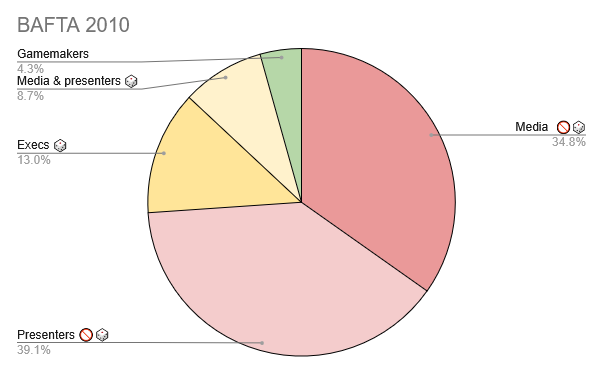
The method for this was quite simple. I brought up the VOD, scrubbed through each award being presented, and noted down who presented it and what category they were in. After doing that, here’s the numbers for this year:
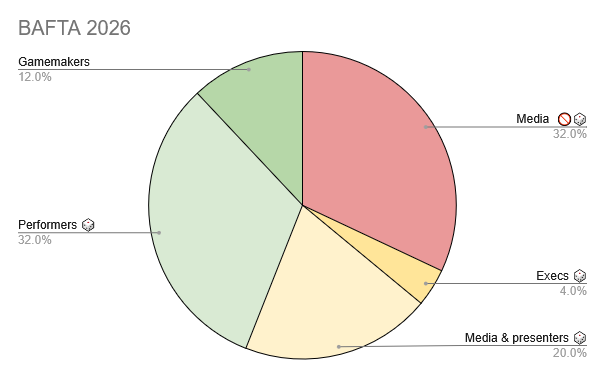
I will be honest, that I expected this split to be worse. Sat there, back row, no bottles of water like every other row had, it felt like someone green came along once in a blue moon. Seeing the numbers genuinely surprised me. Equally, though, why should we settle for this? At a game award show, I would like to see people involved in making games. I don’t think we should settle for only 2/3rds of people being extended family, and not even 50% a part of, you know, actually making a videogame.
So, wanting to see how this holds up over the years, I went back to 2025.
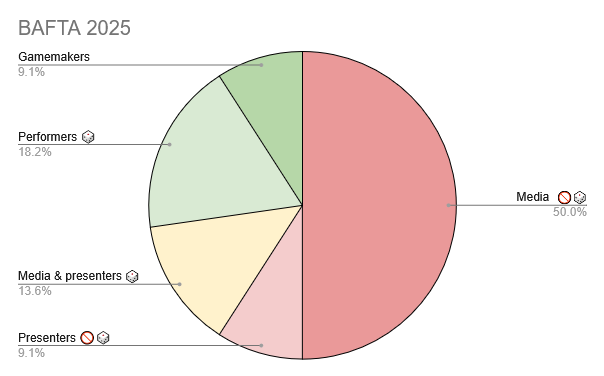
It’s here I realised we’re in for something.
Committing to doing a full sweep, seeing if these numbers got better over time, worse, something else that transcends logical category, we’re going back all the way to 2010. This cutoff is based entirely on how far back the VODs go on the BAFTA youtube channel.
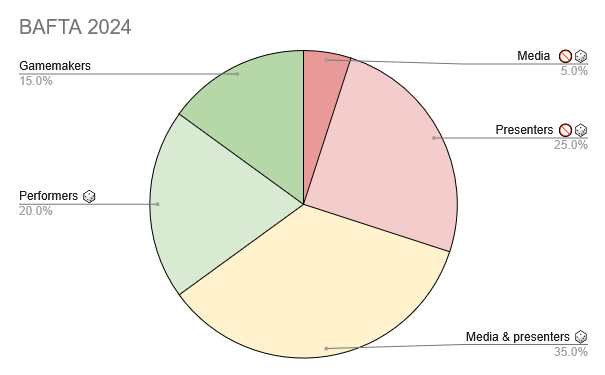
2024 is the best year for gamemaker numbers we have so far. This is still the absolute dregs, I should stress, but I suppose it’s better than nothing.
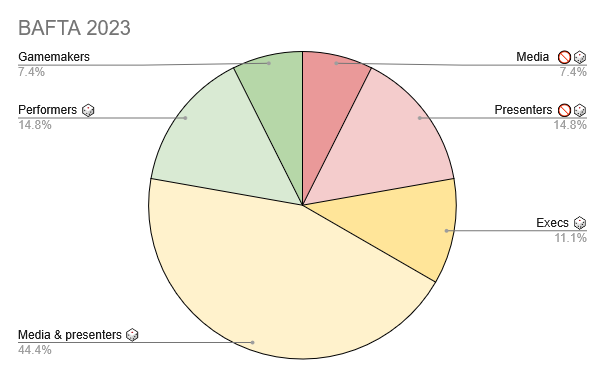
2023 is a bizarre year. For some reason, BAFTA decided to have one award presented by a 6 person esports team, contributing to a huge bump in games media, along with an odd fixation on getting streamers and games execs to present. This is the lowest percentage of gamemakers and performers so far.
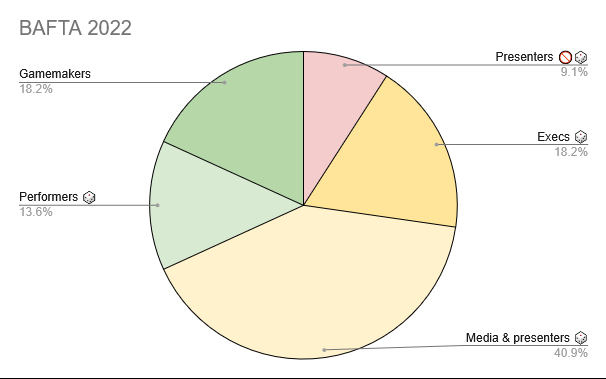
And here we have a pattern. For two years running, it seems, BAFTA wanted to put streamers and execs everywhere. But, hey, I guess we should be thankful that we now have a solid majority of people who actually interact with games in any capacity. I guess. This, so far, makes 2022 the clear winner. If every year was like this, I might still be writing this post, but making very different points.
Also, shoutout to the UKIE CEO who joint-present with a BAFTA young games winner, and proceeded to take up all of the time talking. Classy.
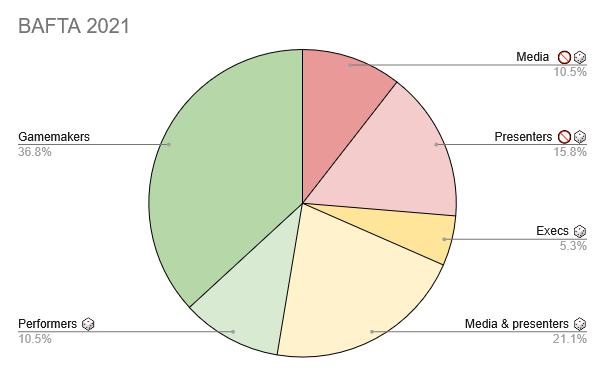
You know what I wrote down for this one when I was three-quarters through? That gamemakers and performers finally breached 50%. Pop the fucking champagne. So funny and sarcastic etcetera etcete-rah. The reason for this getting so close is one award being presented by the Play Watch Listen crew, which adds 3 gamemakers to the pool, doubling the number. Doubling it.
And then, I watched that percentage slowly whittle away.
For some ungodly reason they left the chat replay on the VOD this year.
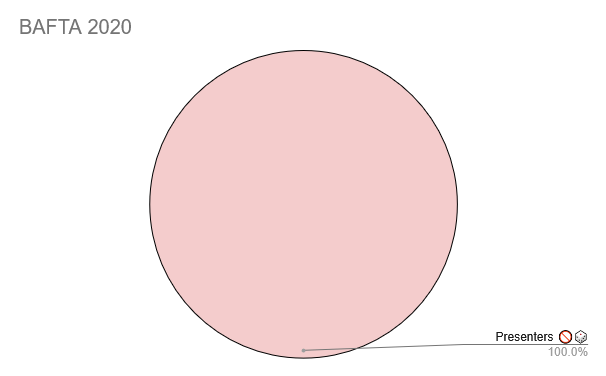
Dara Ó Briain is the main host this year, and thanks to loading up all my tabs beforehand, I already knew he hosted every single BAFTA games awards for each year prior. It is, however, very funny to get introduced to this decade-long run at its end with him presenting in front of a school projector on a webcam from the mid 2000s.
And then I realised, disbelief turning into an unhealthy cackle, that he was the only person presenting anything. He introduced every award, handing off to no-one else. What a finale.
So, thanks to the cunt of the century, also known as covid, we get the worst ratio so far.
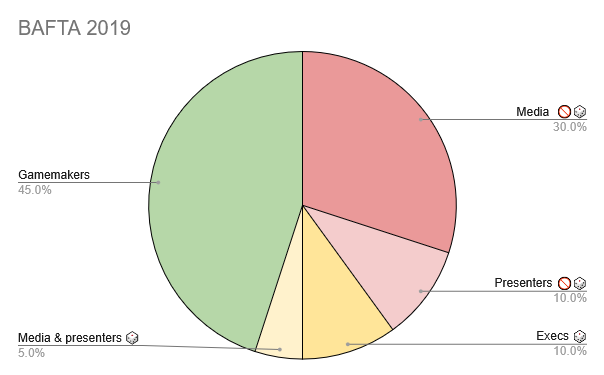
This was on such a good streak. Three gamemakers in a row near the start, thinking we’d finally hit a year where the 50% curse is broken, which then comes to a screeching halt.
There’s also something you’ve probably noticed. No games performers. Interestingly, there’s only one award for performers. It’s not until 2020 when it gets split into Lead and Support.
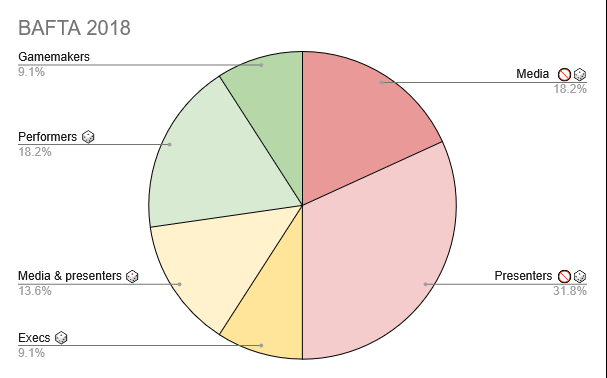
Looks like 2019 was a fluke, and games performers are back in force. Not enough force, unfortunately, to make any games-related people more than half of those present.
Shoutout to whoever put sponsorblock sections on this VOD whenever there’s mention of whatever corp threw money at the event for a tax break. Also for skipping over the publisher speaking for the mobile games winner, which is a bit mean but also very funny.
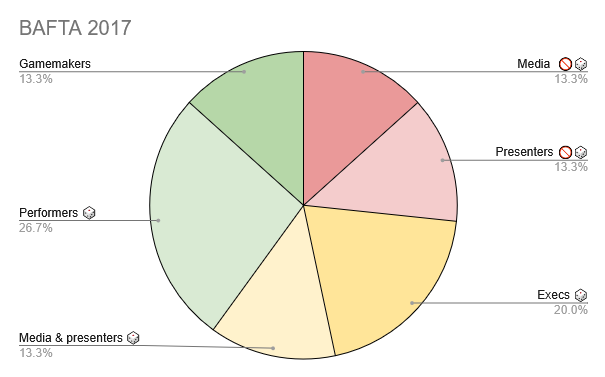
Well, it turns out I missed a year when Dara wasn’t presenting. Decade-with-intermission streak, I suppose. This year also has a different venue from the years that come over, marking 2018 as the point the awards get an aesthetic upgrade.
The execs are at their highest percentage so far. [redacted].
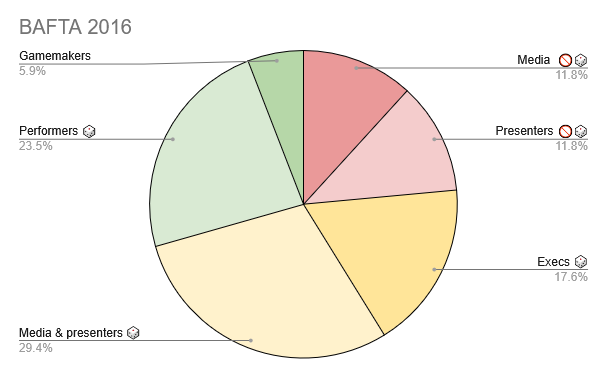
There was one gamemaker this year. I’m sure glad we gave one of the spots to an athlete.
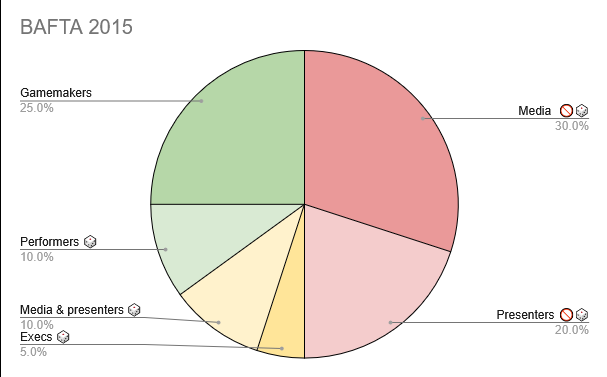
Make that two intermissions for the Dara streak. As if anyone gives a shit.
A stage magician presents the most prestigious award.
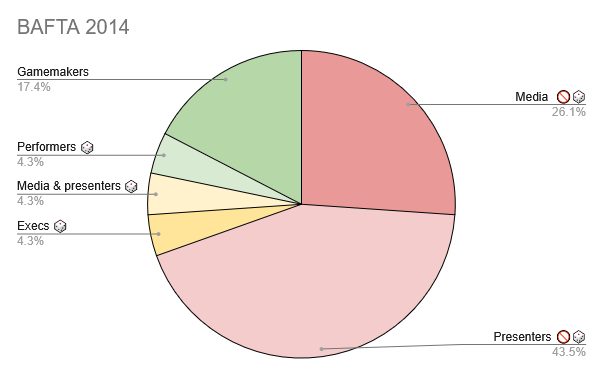
Hm.
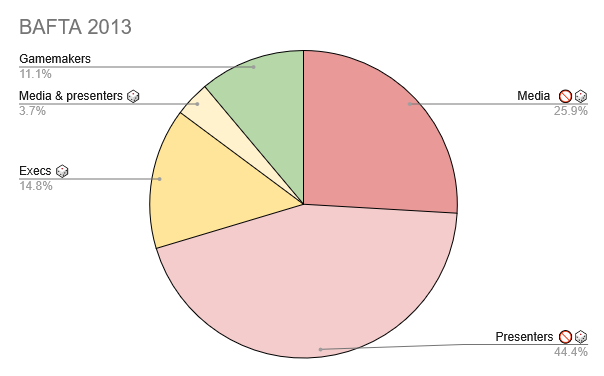
Can you tell my patience has run out?
There were a lot of sports personalities this year. It’s then I realise this was in the wake of the Olympics.
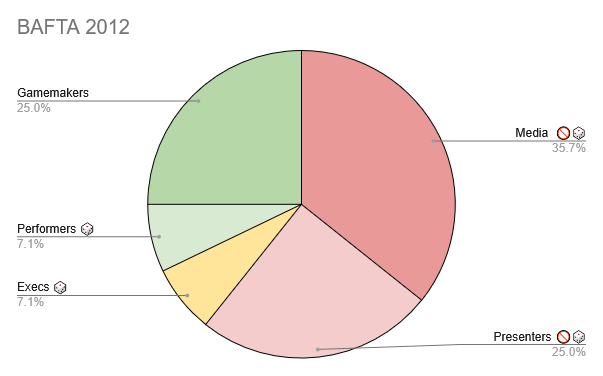
I’ve noticed they liked to stick a dev next to a comedian or other personality with a pretty face, which says a lot.
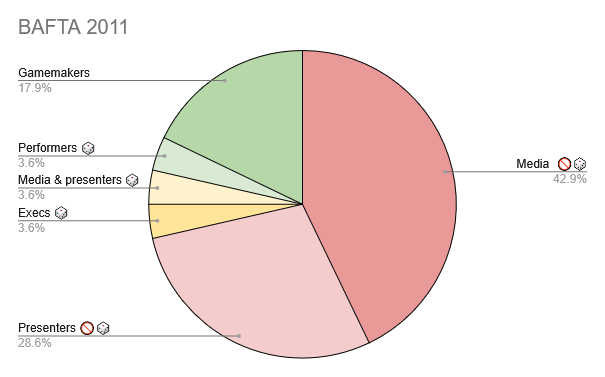
Some band from Eurovision was here.
Now you’re just fucking with me.
The Numbers
The numbers speak for themselves in many ways. I would like to say that there’s an upward trend over time, that there are gradually more and more people in the games sphere, somewhere, who present awards. And… yes?
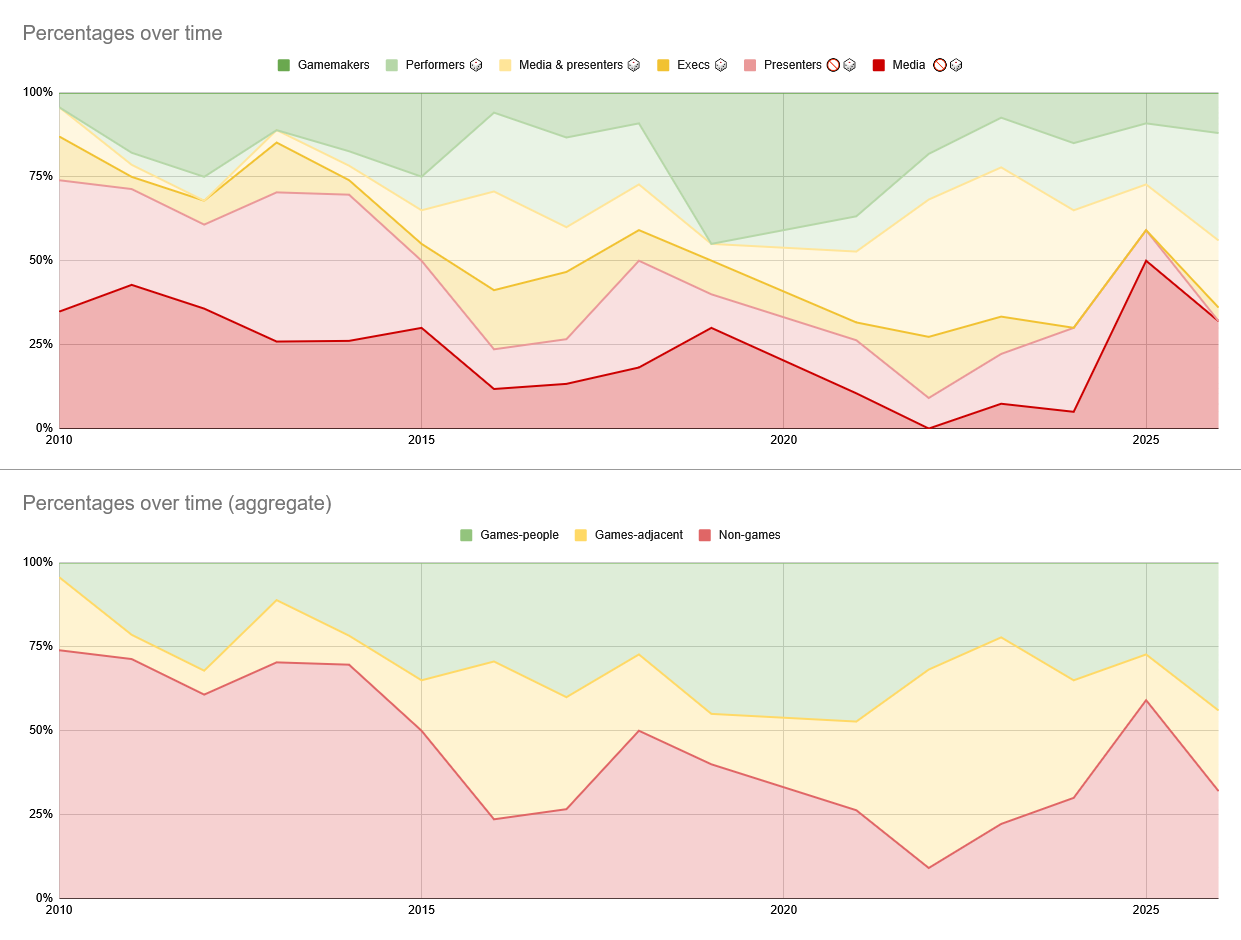
We can see that, especially compared to the early days, there’s a slow increase in the amount of games-people and the games-adjacent, with a phasing out of other random personalities. But it’s just not, like, committed. It feels like there’s been no major shift that says that games should be presented by the people who actually know how games are made. If anything, it feels like streamers and the like are being dragged in because they’re more famous among the audience watching this, compared to the personalities of the early 2010s.
This is where I think the uptick in games media comes from. I still think more attention needs to be put on the actual developers, but, I guess this is a step in the right direction. I guess. And it’s not even that big a step, either. Whatever happened to its golden years of 2022 and 2023 got gutted in the years after. I doubt 2027 will be much different.
There’s also been a steady trend in more attention on games performers. But, even with the split award, it feels symbolic at best. Would you see a games performer brought out to present an award over an actor for whatever TV series is hot shit this month? Unless they are, very specifically, Troy Baker or Ben Starr, which is a real win for diversity.
It’s now worth seeing all of this tallied in one place, and this is where I’m throwing a slight curveball. You see, many of these people have presented a BAFTA multiple times. And, the notable part, almost everyone who’s a repeat is a gamemaker. Ian Livingston is there seven fucking times, because no-one else on the planet makes videogames, apparently.
For our final count, I’m removing duplicates. What does this all look like together?
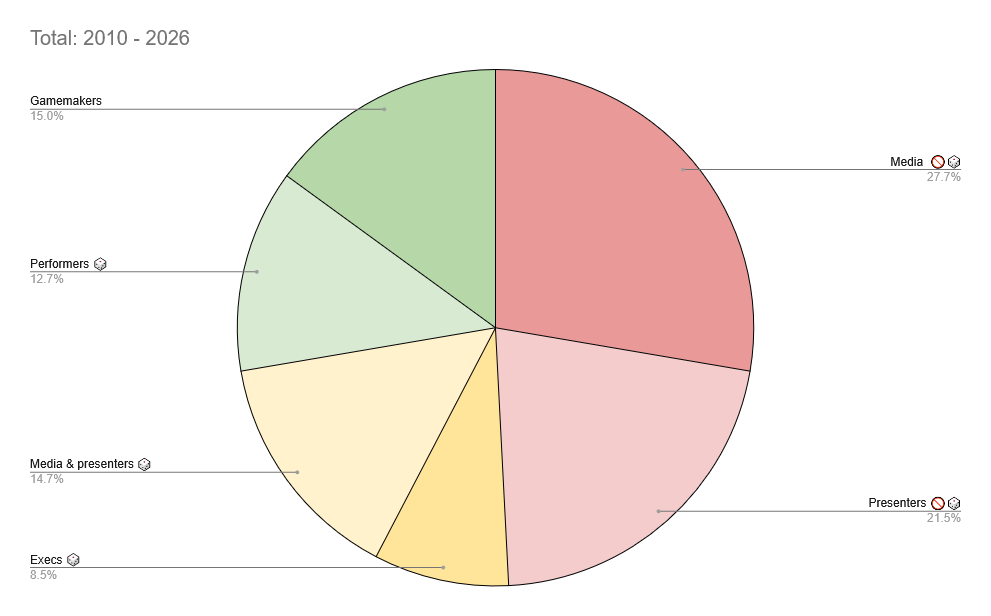
So, in total, over 17 years of BAFTA games:
-
Of the 307 people who presented awards, 46 are gamemakers.
-
About 70% of people who presented awards are not involved in game development.
-
Just under 50% are not involved in games in any capacity.
-
In 8 award shows (ignoring 2020), people in or adjacent to games do not make up the majority of those presenting.
-
There has never been an award show where game devs (including performers) are the majority of presenters.
But, you might be saying, it’s just an awards show, right? Every awards show does this. It’s all about inviting other industries over, making a big show about how good you are compared to them, throwing them a bone by letting them show off one of your very prestigious awards. Or, covertly boosting yourself at their expense. That’s what everyone does. It’s normal. Right?
So, how do the Film Awards look?2
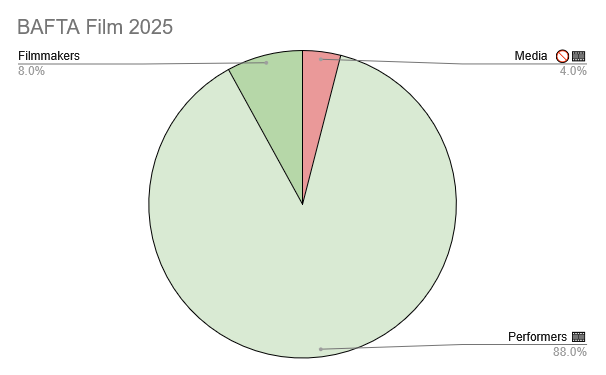
i don’t like this
What we see here is a symptom of a wider issue within games. Or more, the games industry. I remember one time I went to a BAFTA meetup in Manchester. There were some roundtable speakers, there to convince you how healthy the arts are because a few people at the top think you can chant “opportunity” enough times and spontaneously summon jobs. The film and TV people spoke to the importance of what they do. How their work uplifts marginalised groups, gives voices to those whose stories might never be told, and, even in the “shlocky” and frivolous output, gives people a certain amount of joy in hard times. Our one games rep? Milquetoast middle-aged white man? Well, of course, speaking with the timid cockiness of a small business owner, dragged out the statistic that the games industry is bigger than film and TV combined. He did not say anything else.
I have a love-hate relationship with that statistic, because it’s such a perfect microcosm of how the games industry sees itself. It wants to position itself against the only other cultural industries it’s known since it came into the world, the ones that, once it can just be better than them, it will finally be accepted as a real artform. At the same time, by positioning its entire concept of “better” as making more money than everyone else, it reveals what it actually thinks of itself as a cultural phenomenon. “Just games”: vapid, wasteful, and having to justify its existence with profit.
The games industry does not believe it contributes anything to culture. Which is shocking because the games industry has, in so many ways, entirely won as a cultural industry. Ask someone on a street what a videogame is. They’re likely to say Fortnite, or Minecraft, or Battlefield of Call of Duty or whatever other military-funded bullshit is being sold today. All work that’s come from, or been subsumed back into the industry. “Videogame” is synonymous with “games industry output”. This is a complete cultural victory.
But it can never rest on that victory. In the lie it tells so many others, that an industry is the only place where a medium can be produced, it has to put forward first that games’ only value is in profit. To openly show how a game is made to the world, to shift that perception among people on the street that they, too, can make a videogame without needing to join a studio, would destroy the illusion, that games are a wide cultural practice and not a product siloed to a very narrow corner of the commercial world. It cannot sell any other version of games. Then it starts to believe its own lies, as believing anything else would be to concede this victory.
And then, really, this victory is hollow. The industry knows this is a hollow victory, or it wouldn’t be spending all this time screaming and crying to everyone else that its narrow view of games is worth something. Rather than speaking on craft, skill, or self-evident merits as an art, it has to try dragging in (in its own view) more culturally relevant figures to say that Games Are Good, and couch any achievements in irony-poisoned language. We know this is a waste of time. We know games are just about shooting people. We know this, you see? Therefore, you cannot critique this single view of what games are. Here’s a footballer talking about FIFA.
The games industry is always better than you, but always wants to be something that it’s not. Yet, alternatives cannot be conceived.
I find notable the shift in language over time from people who present BAFTAs. In the 2010s, we start in the classic capital-G Gamer lingo. Laddy bants and thinly veiled bigotry; no one who plays games also plays sports; “my wife hates that I play games”. In later years, there’s now this shift to games as magic. How they impact so many people. How they can make worlds come to life. How they do this? Well, we simply don’t know, because anyone culturally relevant doesn’t know how to make a game. Going against the industry dogma, now trying to insist the counterview that games are, as their existence proves, an art and cultural force, then creates an ultimate sum of nothing, because industry bodies can never escape themselves.
It’s tempting to say that videogames need to grow up. The thing is, videogames have already grown up. The medium has more than matured into itself and has never been healthier and more accessible. More than enough individual devs have realised that, or they wouldn’t be fighting tooth and nail to keep making them under industry “stability”, or striking out into the fringes with a friend who makes music and two coins for the ferry ride.
The industry, however? It cannot escape self-made hell without destroying the foundations of its own existence. It will remain in a gilded cage until the end of time.
-
I’m not releasing the dataset right now because it’s messy and I can’t be arsed tidying it up. If there is, somehow, a huge demand for it, I’ll put it out at some point in the future. ↩︎
-
To stress, I still think that the film awards have an issue here. More attention needs to be put on filmmakers, and not just the directors at the very top. But, for fuck’s sake, at least they have the gall to pull from their own talent pool. ↩︎